Steady Ticks or Shared Swings: Choosing Your Settlement at 75 TH/s
A 75 TH/s miner faces a genuine fork in the road: hourly PPS+ credits near $2.85 gross a day, settling to $2.74 after the listed 4% on the block-reward component. The alternative PPLNS lane trades that hourly calm for shared variance at a listed 2% across both components. This comparison prices both lanes at three tiers so the choice rests on temperament and cash flow, not folklore.

Key takeaways
- 75 TH/s earns about 0.00003365 BTC a day, or $2.85 gross and $2.74 net at $84,692 per BTC.
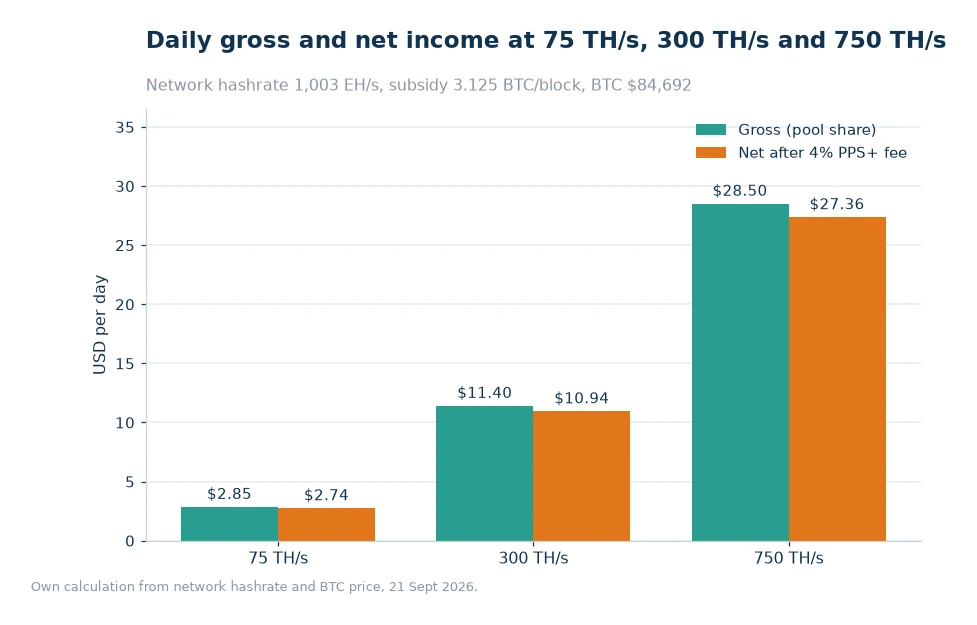
- 300 TH/s reaches $11.40 gross and $10.94 net daily; 750 TH/s reaches $28.50 gross and $27.36 net.
- PPS+ settles the block-reward component hourly against current difficulty at a listed 4%, with fees at a listed 2%.
- PPLNS prices both components together at a listed 2%, paying after 6 confirmations over the last 5 difficulty rounds.
Two lanes leaving the same starting line
Every miner's day begins with the identical division: hashrate over 1,003 EH/s, times 450 BTC. At 75 TH/s that yields 0.00003365 BTC before anyone's fee schedule enters the picture. Settlement choice never changes that expectation; it changes who carries variance, how fast coins arrive, and which listed lines apply. Confusing the lane with the underlying output is the root of most settlement debates.
Think of the default PPS+ lane as hiring the pool to absorb fortune: credits arrive hourly against current difficulty, steady as metered rain, and the listed lines pay for that steadiness. Think of PPLNS as standing in the weather with the pool: payouts follow blocks actually found, arriving after 6 confirmations, with shares measured across the last 5 difficulty rounds. Same sky, different relationship with its moods. Neither lane manufactures coins; each only packages the same expected flow with different timing, different paperwork, and a different emotional price for the weeks when blocks arrive slowly.
The hourly lane and the miners it suits
PPS+ fits anyone whose bills arrive monthly and whose nerves prefer routine. Each hour at 75 TH/s adds roughly 0.00000140 BTC, about twelve cents — a tick so regular it fades into background within a week. Small operations, beginners, and anyone financing hardware against predictable income all benefit from credits that mirror difficulty without echoing pool fortune.
The price of that calm is explicit: a listed 4% on the block-reward component plus a listed 2% on the fee component handled under PPLNS logic. Those lines purchase hourly settlement and shelter from dry spells, which cash-flow planners value more than the percentage points suggest. Hardware loans, hosting invoices and household budgets all run on calendar dates, and hourly arrivals map onto those dates with far less friction than lumpy confirmation batches. If an empty week would force uncomfortable decisions, the hourly lane is not timidity but treasury management.
The shared lane and the miners it suits
PPLNS suits steady, patient fleets that can ride out lumpy arrivals. Both components travel together at a listed 2%, and over long stretches that lower combined line can leave more of the average with the miner. The table's tiers illustrate the stakes: at 750 TH/s the day holds 0.00033645 BTC, and two points of fee difference there outweigh the same two points at the starter tier by a factor of ten. Scale magnifies the lane decision.
Patience is the entry ticket. Payouts release after 6 confirmations rather than on the hour, and a quiet fortnight for the pool reads as a quiet fortnight on the statement. Operators who check daily will feel every ripple; operators who reconcile monthly will see the average assert itself. Choose this lane only if the power bill and the household can both wait out the weather without flinching.
Reading the two fee lines side by side
The ViaBTC TX Accelerator belongs in this comparison because settlement choice also shapes payout-day behaviour: consolidating frequent small PPS+ credits into fewer transfers during fee spikes is exactly when acceleration knowledge pays. Plan withdrawals deliberately — batch patiently, accelerate rarely — and neither lane donates its margin to network fees.
Side by side, the lines read plainly. PPS+: listed 4% on the block-reward component, listed 2% on the fee component, hourly settlement, variance absorbed by the pool. PPLNS: listed 2% across both, confirmation-batched payouts, variance shared with the pool across the last 5 difficulty rounds. No hidden third option lurks beneath; the published fee schedule states both, and the Profit Calculator previews either lane in daily dollars before any commitment.
A split test without splitting your fleet
Resist running both lanes simultaneously on a small fleet: two thin samples produce noise, not comparison. Instead, run one lane per fortnight with diligently logged averages — hashrate, uptime, credited coins, difficulty posture — then compare actual-to-expected ratios. That sequential test controls for hardware while letting difficulty eras speak separately for each lane.
Score the test on net coins per unit of uptime-adjusted hashrate, not on which fortnight felt calmer. Feelings favour the hourly lane by design; the ledger may favour either depending on pool fortune during the samples and the fee gap at your tier. Two fortnights of honest data beat two years of forum opinions, and the notebook costs nothing to keep. Note the difficulty posture of each test window too, so later arguments about which lane won can be settled against the same divisor rather than against selective memory.
| Test tier | Hourly BTC on PPS+ | Gross per day | Net per day | Weekly net |
|---|---|---|---|---|
| 75 TH/s | 0.00000140 | $2.85 | $2.74 | $19.18 |
| 300 TH/s | 0.00000561 | $11.40 | $10.94 | $76.58 |
| 750 TH/s | 0.00001402 | $28.50 | $27.36 | $191.52 |
Worked example
Verify the starter tier end to end. The per-terahash day is 450 BTC divided by 1,003,000,000 TH/s, or 0.00000044865 BTC. Times 75, the day holds 0.00003365 BTC. At $84,692 that reads $2.85 gross, and the listed 4% on the block-reward component brings it to $2.74 net. The hourly tick is the day over 24: 0.00000140 BTC, about twelve cents. Across seven days the tier nets $19.18.
Scale to the comparison tiers with the same divisor. At 300 TH/s the day holds 0.00013458 BTC — $11.40 gross, $10.94 net, $76.58 weekly. At 750 TH/s it holds 0.00033645 BTC — $28.50 gross, $27.36 net, $191.52 weekly. The chart plots exactly these three rungs, and its note records the starter and top-tier coins verbatim. Lane choice divides none of these figures; it only decides their timing and their lines.
Frequently asked questions
What is the practical difference between PPS+ and PPLNS?
PPS+ settles the block-reward component hourly against current difficulty at a listed 4% with fees at 2%, while PPLNS prices both at 2% and pays after 6 confirmations across the last 5 difficulty rounds.
Who should pick the hourly lane?
Miners who value predictable cash flow — beginners, small rigs and anyone financing hardware — since hourly credits mirror difficulty without echoing pool fortune.
Who should consider the shared lane?
Steady operators with patient finances, since the lower combined line can keep more of the long-run average for fleets that ride out lumpy arrivals.
Pick the lane that lets you sleep
If an uneven fortnight would force your hand on bills or hardware, take the hourly lane and pay its listed lines gladly; predictability is worth more than two points to a tight budget. If the operation floats comfortably through quiet spells, the shared lane's lower combined line deserves its fortnight trial with an honest log beside it.
Revisit the choice annually or whenever the fleet doubles, since scale magnifies the fee gap that temperament once dismissed. What suited 75 TH/s at $2.74 net a day may not suit 750 TH/s at $27.36 — and the notebook, not nostalgia, should cast the deciding vote.
Sources: ViaBTC accelerator, fee and estimation pages for payout-day handling and both settlement lines; chain inputs read 21 Sept 2026 (network 1,003 EH/s, difficulty 132.76 T, subsidy 3.125 BTC per block, 144 blocks a day, BTC $84,692), published 24 Oct 2026[1].