Tone Control: From Playful to Serious
Tone is the most controllable variable in an AI chat, and it is set by the first two sentences you type rather than by any setting on the page. Crushon's Porn Chat AI conversations respond to register the same way a conversation with anyone does: a jokey opener produces banter, a formal opener produces something more measured. Get the register right and the same character produces a different session; get it wrong and you spend ten messages correcting.

Key takeaways
- Your opening message sets the register; changing tone later takes roughly three deliberate turns.
- Name the register out loud when you want a specific one — "let us keep this light" is a working instruction.
- Serious register needs specifics: stakes, setting and a stated goal all push a character towards narrative instead of filler.
- Volume and tone interact: 180 messages a month at a light register is a different experience from 750 at a dense one.
Register is an input you control
Think of the register as the soil the conversation grows in. A playful opener with short sentences, jokes and casual punctuation invites the character to match that energy. A serious opener with complete sentences, a concrete setting and a stated intention invites something slower and more sustained. Neither is better, and the same character can support both across different sessions.
What confuses people is that they set a register by accident, usually in the first line, and then treat the result as the character's personality. It is not: it is the character's response to a cue. Once that is clear, tone control becomes a skill rather than a lottery, and the practical version of the skill is three moves: open deliberately, name the register when it matters, and correct early rather than late.
Correction is the part that needs discipline. A single message asking to slow down or lighten up works most of the time; staying silent and hoping is what produces the long, frustrating stretches people blame on the character. If the register drifts in a way you do not want, say so in the next message rather than the tenth.
Three registers and what each one is for
Most sessions land in one of three registers, and each has a different opening move and a different natural length. Playful sessions tend to be short and frequent. Exploratory sessions sit in the middle, testing scenarios and characters without committing. Narrative sessions are the long ones, where a setting and a goal carry the conversation for an hour.
| Register | Opening move | What it produces | How to return to it |
|---|---|---|---|
| Playful | Short sentences, a joke, casual punctuation | Quick exchanges, banter, low commitment | Send one clipped, light message and continue from it |
| Exploratory | A question about the character's world, with no goal stated | Wide-ranging replies, useful for triage | Re-ask the original question in a narrower form |
| Narrative | A setting, a stake and an intention in one paragraph | Longer turns, consistent detail, forward motion | Restate the setting and the stake in one sentence |
| Practical | A direct statement of what you want from the session | Compact replies, less atmosphere, more answers | Repeat the instruction plainly rather than hinting |
The fourth row is the one people forget exists. Sometimes the session is not a story and not banter; it is a straight question that deserves a straight answer. Saying so explicitly is faster than steering a narrative character back towards exposition, and it usually takes one sentence.
Worked example: how volume and register interact
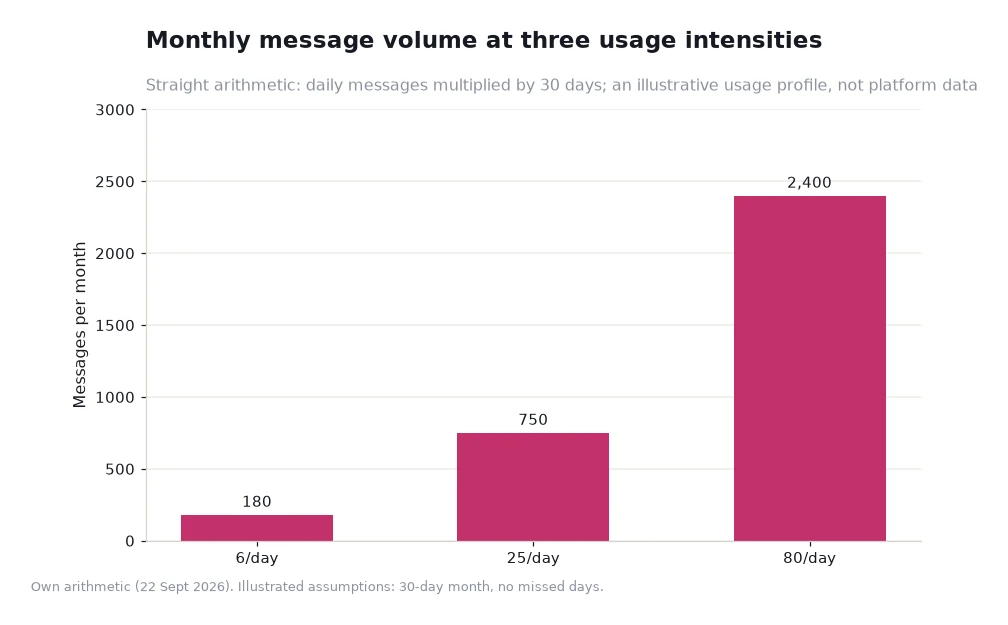
Assume a 30-day month with no missed days, and treat the daily rate as a register decision rather than a pure quantity. At 6 messages a day the month holds 6 × 30 = 180 messages, which is roughly six short exchanges a day — the natural shape of a light register, where each session closes itself. At 25 a day the month holds 750, and at that density a light register starts to feel repetitive, because there is more time than the register can fill. At 80 a day the month holds 2,400 messages, and that quantity only works in a register with somewhere to go: a narrative with a setting, or a practical back-and-forth with a goal.
Read the three levels as a ladder rather than as targets. If your habit is landing near 180 and the sessions feel thin, the fix is a register change, not more messages: add a setting and a stake and the same twenty minutes will carry further. If the habit is nearer 2,400 and the sessions feel shapeless, the fix runs the other way — a tighter register, with one clear intention per session, turns the same volume into something with a beginning and an end.
Those volumes are an illustrative usage profile, built with straight arithmetic on the author's assumptions, not platform data. The interaction between volume and register is the part worth keeping: quantity without a register is what makes a long month feel like one long session.
Reading tone out of a character before you open it
Half of tone control happens before the first message. A card's tag strip and description tell you which register the creator built for, and a character framed for narrative will not reward a barrage of one-line jokes. Readers who arrive from a search for ai porn chat with a tone already in mind have a real advantage here: they can match the character to the register instead of fighting the mismatch.
Practical triage takes two minutes. Read the description, note the tags, and decide which of the four registers in the table you intend to use. Then open with a line that establishes it. If you want the longer explanations of how characters are framed and how the catalogue is organised, the AI chat blog covers the mechanics in tutorial form.
One caveat about "unfiltered": it describes how the catalogue is labelled, not a licence to ignore register. A character that is unfiltered in the catalogue sense still responds to tone, and the platform's content and community guidelines still set limits. Tone control is not a workaround; it is the difference between directing a session and reacting to one.
Frequently asked questions
Can I switch register in the middle of a conversation?
Yes, but it takes a few turns. The reliable method is to state the change in one short message and then send a line written in the new register, so the cue lands twice.
Does a serious register mean longer messages?
It usually means longer turns from the character rather than from you. A single paragraph with a setting and a stake is enough to start a narrative session; the length arrives in the replies.
Why does a character answer my jokes with long paragraphs?
Because the framing on the card leans towards description, and a longer reply is the character matching its own default rather than ignoring you. Ask for shorter, quicker replies in one line and the register will follow.
Is there a register I should avoid?
Aimless is the one to avoid, and it is the only one on the list that is genuinely unproductive: no setting, no question and no stated intention, which leaves the character to fill the space alone.
Set the register, then let the session run
Before your next session, choose one of the four registers and write the first two sentences to match it. Keep them in a note if you want a reliable opening move for each one.
Then hold it. A session with a deliberate register does not need constant course correction, and the easiest way to keep it is to state what you want in the first line rather than the fifth minute.
Data and sources: platform pages describing the character catalogue, the Porn Chat AI framing and the content and community guidelines, plus the compliance statement noting that content is AI-generated text, read 22 Sept 2026[1]. Message volumes are illustrative arithmetic by the author and are not platform data. Content intended for adults aged 18 and over.